 We provide extracts from the UK company register, covering England, Wales, Scotland, and Northern Ireland, as well as Jersey, Guernsey, the Isle of Man, and Gibraltar, with an apostille and translation.
When Registry Extracts Are Required
An extract from the commercial register is the primary document confirming the legal status and managerial authority of a British company. It is required to verify corporate details during any official interaction with government bodies and financial institutions.
Unlike the practice in continental European countries, a commercial register extract in the United Kingdom does not have a single standardized format. Instead, it consists of a set of public registration records and official documents generated by the UK Registrar of Companies (Companies House). Understanding the structure of these records, the procedure for obtaining them, and their legal force is essential for conducting comprehensive counterparty checks (due diligence), structuring commercial transactions, and handling litigation involving UK legal entities.
- Banking operations: opening bank accounts, obtaining loans, and passing compliance checks.
- Transactions and contracts: verifying signatory authority and the legal standing of a counterparty.
- Notarial actions: executing real estate transactions or amendments to a company's articles of association.
- Tenders and licensing: confirming registration to participate in procurement and obtain permits.
- Litigation: filing claims and confirming the legal status of a defendant or claimant.
- Investment audits: verifying shareholding history (Due Diligence).
Information from the UK commercial register is provided as an electronic PDF document. If required, documents can be sent by post in notarized form or with an apostille.
Searching for and obtaining an extract is possible using the following criteria:- full company name
- company registration number
What Is the UK Commercial Register
The UK Commercial Register (Companies House) is a public state information resource managed by the Registrar of Companies for the United Kingdom, an executive agency of the Department for Business and Trade. The agency's headquarters are located in Cardiff (Wales). The British registry relies on long-standing historical traditions: the first registration records in England appeared in 1844, and a year later the register began operating in Scotland. In 1988, administration of the system was centralized under the unified agency Companies House. The core mission of Companies House is to record, verify, store, and promptly update business information, as well as ensure open public access to this data.
Territorial Structure and Applicable LawThe register covers three separate legal jurisdictions, each with its own regional offices and governing legislation:
- England and Wales (offices in Cardiff and London, governed by English law);
- Scotland (office in Edinburgh, governed by Scots law);
- Northern Ireland (office in Belfast, governed by Northern Ireland law).
Mandatory registration in the register applies to all types of British commercial and non-commercial corporate structures: private limited companies (Ltd), public limited companies (PLC), limited liability partnerships (LLP), limited partnerships (LP), as well as overseas companies operating through branches or establishments in the United Kingdom. Today, the database contains information on more than 5.3 million companies and millions of individuals (directors, secretaries, and persons with significant control — PSC).
Not registered with Companies House:- sole proprietors (Sole Traders);
- unincorporated general partnerships (General Partnerships);
- intellectual property rights and trademarks (their registration is administered by the UK Intellectual Property Office — IPO).
Under the Companies Act 2006 and corporate law regulations, all registered entities—including inactive and dormant companies—are required to regularly file updated information, confirmation statements regarding company officers and members, and annual accounts. Responsibility for the accuracy and reliability of submitted data rests with the companies themselves and their officers. Deliberate concealment of facts or submission of false information to the register carries severe penalties under UK law, up to director disqualification and criminal liability.
Operating Procedures, Extracts, and Document LanguageThe UK commercial register is fully digitized: both record filings and document generation are carried out electronically. A registry extract (Company Snapshot, Certificate of Incorporation, or Certificate of Good Standing) is an official document reflecting the company's current status, share capital, registered office address, management structure, and history of registration filings. To quickly search for and generate an extract, it is sufficient to provide the official company name or its Company Registration Number (CRN).
All registry records are maintained and issued in English (in Wales, documentation in Welsh is also available upon request). For use in international document workflows and foreign government agencies, extracts from Companies House can be officially translated.
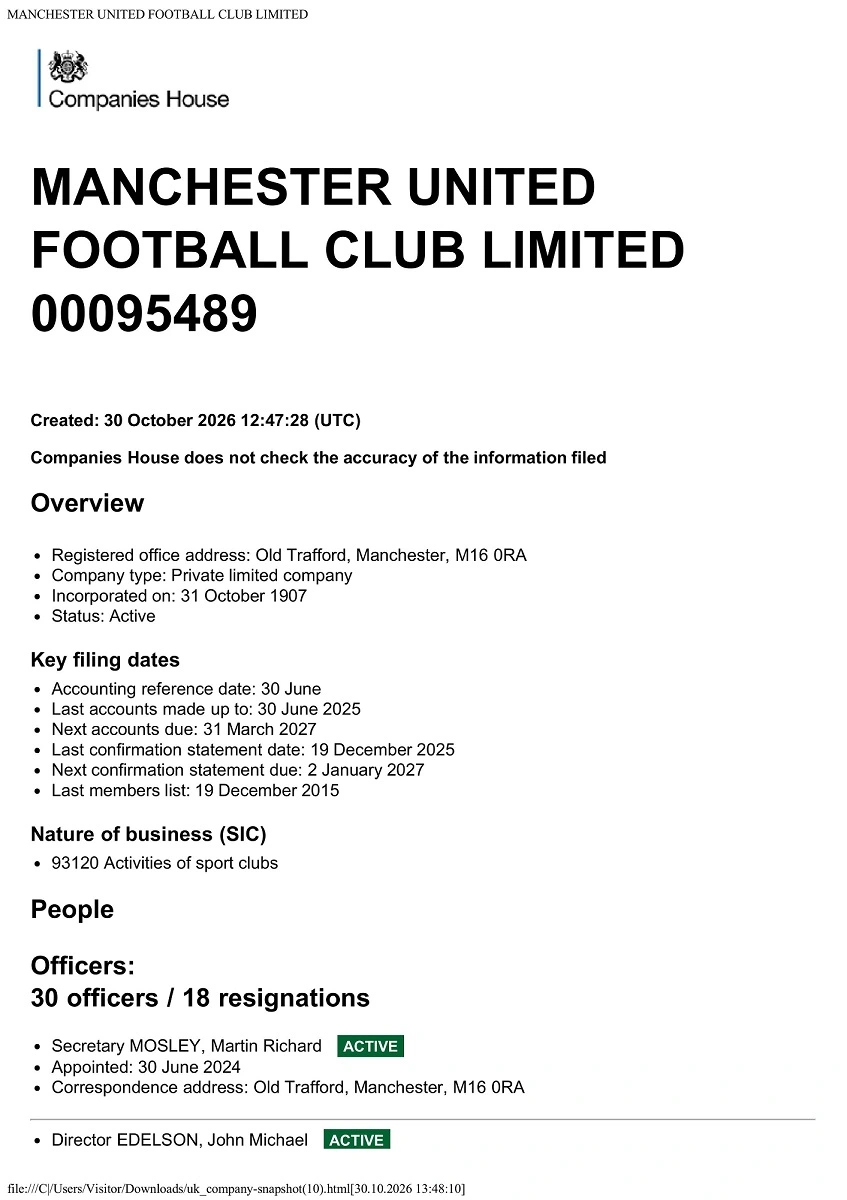
Company Snapshot – an official document containing up-to-date information on the legal status of a United Kingdom company at the time of the request. This is the most frequently requested document.
A Company Snapshot contains:- company name
- registration number
- legal form
- registered office address
- date and place of incorporation
- filing history in the register
- previous company names (if any)
- details of directors, secretaries, and authorized signatories
- amount and structure of share capital
- company status
- some of the listed details may be unavailable for a specific entity or may be provided for an additional fee.
Order processing time: from 30 minutes.
Cost of extract with apostille: 250 €

Certificate of Incorporation – a certificate confirming the registration of a company in the United Kingdom. This is the primary official record verifying the fact of company incorporation.
A Certificate of Incorporation contains:- company name
- legal form
- date of incorporation
- some of the listed details may be unavailable for a specific entity or may be provided for an additional fee.
Order processing time: from 30 minutes.
Cost of extract with apostille: 250 €

Certificate of Good Standing – an official document confirming the legal capacity and proper legal standing of a British company. Obtaining this certificate confirms that the legal entity complies with all UK statutory requirements, is not in liquidation, bankruptcy, reorganization, or merger proceedings, and files its corporate returns on time.
Order processing time: from 30 minutes.
Cost of extract with apostille: 250 €

Memorandum of Association - a copy of the founding memorandum signed upon the incorporation of the company in the United Kingdom.
Order processing time: from 30 minutes.
Cost of extract with apostille: 250 €

Appointment of Director or Secretary – a copy of the official filing confirming the appointment of a specific company director or secretary.
Order processing time: from 30 minutes.
Cost of extract with apostille: 250 €
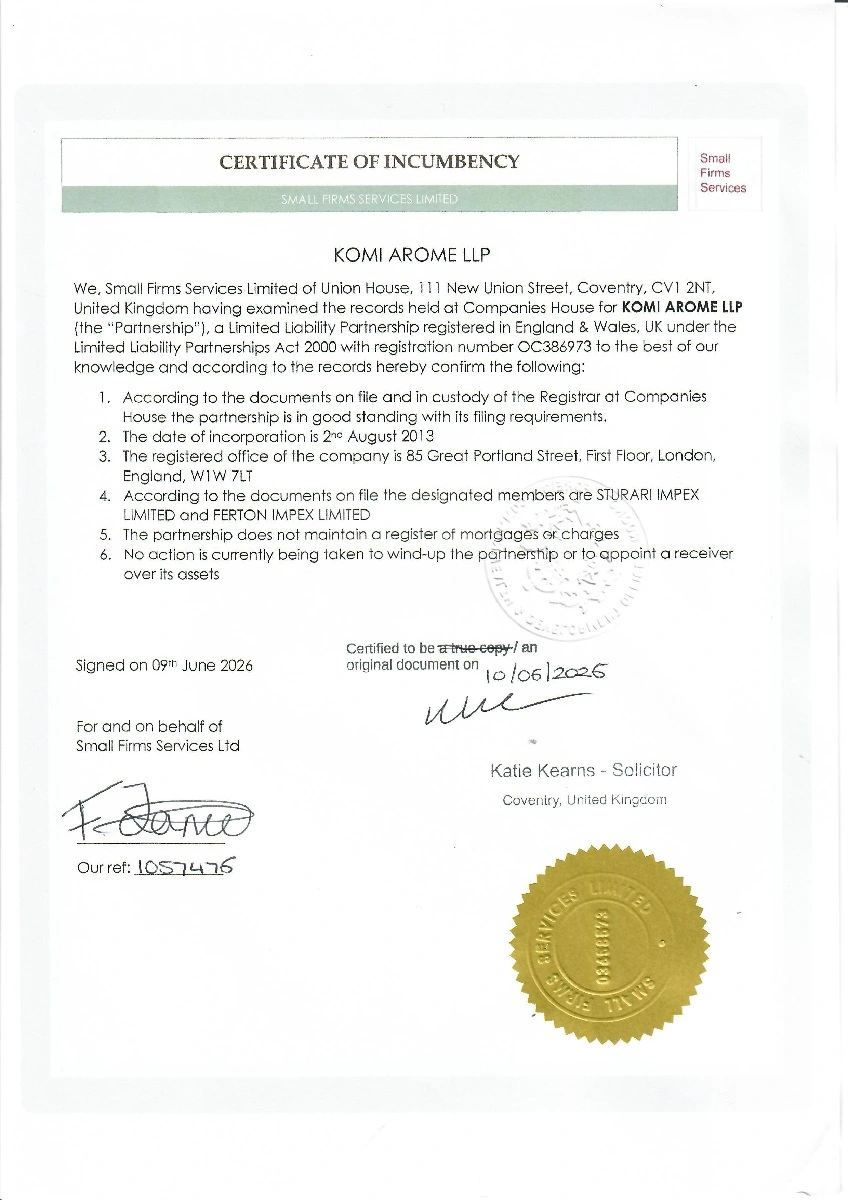
Certificate of Incumbency – a certificate confirming the identity and authority of company officers. The document is issued as of the current date and is suitable for submission to courts or tax authorities in the Russian Federation.
Important: This certificate is issued and certified by a UK Notary Public.
A Certificate of Incumbency contains:- company name
- registration number
- registered office address
- date of incorporation
- information on directors, secretaries, and shareholders/founders
- information regarding any insolvency or liquidation proceedings
- some of the listed details may be unavailable for a specific entity or may be provided for an additional fee.
Order processing time: from 30 minutes.
Cost with apostille: 300 €
- Application to register a company
- Confirmation Statement
- Termination of a Director Appointment
- Full accounts
- Copies of other filings regarding amendments to the articles of association, board of directors, or registered office address, as well as financial reporting data and records on the commencement of insolvency or liquidation proceedings.
Order processing time: from 30 minutes.
Cost of extract with apostille: 250 €
Jersey, Guernsey, and the Isle of Man
Jersey, Guernsey, and the Isle of Man hold the status of Crown Dependencies of the British Monarchy. They are not part of the United Kingdom and possess their own parliaments, governments, and autonomous legal systems: Manx law applies on the Isle of Man, while Jersey and Guernsey operate under a blend of Norman customary law and English common law. Acts of the UK Parliament do not extend to them automatically. The islands were never full members of the European Union, and following the UK's withdrawal from the EU (Brexit), their previous limited customs arrangement (Protocol 3) ceased to apply. EU directives do not have direct effect in their territories. Nevertheless, to maintain access to international markets, these jurisdictions voluntarily implement OECD, FATF, and EU financial transparency standards, including economic substance requirements and beneficial ownership reporting.
As internationally recognized financial centers with favorable tax regimes, Jersey, Guernsey, and the Isle of Man host a significant number of international corporate structures. Each jurisdiction maintains its own state register of legal entities containing records on joint-stock companies, limited liability companies, partnerships, and branches of foreign corporations.
Registry administration has been fully transitioned to digital format: searching for data and ordering official extracts and certificates (including a Certificate of Good Standing) are performed online in the form of electronic documents with digital verification.
Extracts from commercial register of the British Virgin Islands
The British Virgin Islands (BVI) is a self-governing British Overseas Territory. It is not part of the United Kingdom and has an autonomous legal system based on English common law, along with its own legislature that enacts local corporate and tax laws.
The BVI is one of the world's largest international corporate registration centers. Driven by OECD and FATF transparency standards, the jurisdiction has gradually moved away from the classic closed zero-tax offshore model, introducing economic substance requirements and stricter compliance rules.
The register of legal entities is administered electronically by the BVI Financial Services Commission (BVI FSC) via the VIRRGIN system. A basic check of a company's existence and status can be performed online, while full electronic reports and certified documents are ordered through the digital portal or licensed registered agents for a fee. The register is partially public: since 2023, third parties may officially request the names of a company's current directors. Information on shareholders and beneficial owners is not publicly accessible; however, data on ultimate beneficial owners must be submitted to the closed government Beneficial Ownership Secure Search System (BOSS) and is disclosed to law enforcement and regulatory authorities.
Extracts from commercial register offrom Gibraltar
Gibraltar is a self-governing British Overseas Territory. The British Monarch is the formal head of state, represented by a Governor, while the territory enjoys broad internal autonomy with its own Parliament and Government. Gibraltar's legal system is independent and based on the principles of English common law.
As a result of Brexit, Gibraltar left the European Union alongside the United Kingdom, meaning EU directives no longer apply directly within its territory. The jurisdiction has evolved from a traditional offshore center into a regulated international hub for finance, fintech, and gaming: Gibraltar applies a territorial corporate tax at a standard rate of 12.5%, levies no VAT or capital gains tax, and adheres to international OECD and FATF transparency standards.
The registration of legal entities and maintenance of corporate records are handled by Companies House Gibraltar. The state register is fully digitized: basic searches, ordering official company profiles and extracts, and filing annual returns are conducted through the agency's secure electronic portal.
Documents for Dissolved Companies
Records of companies removed from the register (Dissolved / Struck off) are retained permanently in the Companies House archives. In such cases, we obtain an extract bearing a dissolution notation (Dissolved) or final liquidation accounts. These documents are required for courts in the Russian Federation to confirm the termination of a legal entity, establish legal succession, or hold former directors liable. Lists of members, financial accounts, and articles of association of closed companies remain accessible and can be obtained in certified paper form with an apostille to confirm ownership structure and authority at the time of closure.UK Register of Beneficial Owners
On June 25, 2014, the United Kingdom introduced legislation establishing a public register of beneficial owners, enacted as the Register of People with Significant Control (PSC Register) under the Small Business, Enterprise and Employment Act 2015. Maintaining an internal register became mandatory for companies on April 6, 2016, and public filing with Companies House commenced on June 30, 2016.
The register records individuals or legal entities that exercise ultimate control over a company: holding more than 25% of shares or voting rights, holding the right to appoint or remove a majority of directors, or otherwise exercising significant influence or control over a company or trust. Submitting false information or failing to file required data carries fines and criminal liability for directors. In addition, since 2022, the public Register of Overseas Entities (ROE) has been in operation, requiring foreign companies owning UK property to declare their beneficial owners.
Any interested party can search the register free of charge. Unlike many EU jurisdictions, basic PSC details (name, month and year of birth, nationality, country of residence, and nature of control) are publicly viewable on the Companies House portal, whereas full residential addresses and exact dates of birth are protected by law. In exceptional circumstances, a controlling person's details may be suppressed from public disclosure if there is a serious risk of violence or intimidation.
Entrepreneurs choosing to conduct business in England should note that almost all corporate structures are subject to the statutory obligation to maintain and file a public register of persons with significant control.
Specifically:- companies limited by shares
- English LLPs
- Scottish Limited Partnerships (SLPs)
- limited companies
- companies limited by guarantee
- UK Societas
- limited partnerships (LPs) (following the enactment of the Economic Crime and Corporate Transparency Act 2023)
- First and last name
- Month and year of birth
- Nationality
- Country of residence
- Date control began
- Service address for correspondence
- Nature of control
Main Legal Forms of Business Entities in the UK
Incorporated Entities (Body Corporate):
- Private company limited by shares (Ltd) — a private company whose liability is limited by shares
- Public limited company (PLC) — a public company limited by shares (joint-stock company)
- Company limited by guarantee — a company whose members' liability is limited by a guarantee (commonly used for charities and associations)
- Limited liability partnership (LLP) — a partnership with limited liability for its members (possesses separate legal personality)
- Registered Society (Cooperative society) — a registered cooperative or community benefit society
Unincorporated Entities:
- Sole trader — an individual entrepreneur / sole proprietor
- Partnership (General Partnership) — a general partnership (in Scotland, it possesses separate legal personality)
- Limited partnership (LP) — a limited partnership (in Scotland, an SLP possesses separate legal personality)
- Unincorporated association — an unincorporated club or association
Other Important Registers
In the UK, Companies House is the central universal registrar for commercial companies; however, specific types of organizations, rights, and assets are registered in specialized databases:- Charity Commission Register: The register of charitable organizations (for England and Wales; in Scotland — OSCR).
- Mutuals Public Register (FCA): The register of credit unions, cooperatives, friendly societies, and building societies.
- FCA Financial Services Register: The register of financial, investment, brokerage, and insurance firms authorized by the regulator.
- HM Land Registry: The register of title to real property (for England and Wales; Registers of Scotland — for Scotland).
- Register of Overseas Entities (ROE): The register of foreign companies owning real estate in the UK.
- Bankruptcy and Insolvency Register: The public register of individual bankruptcies and corporate insolvency proceedings.
Apostille
The United Kingdom acceded to the Hague Convention Abolishing the Requirement of Legalisation for Foreign Public Documents on August 21, 1964, and the Convention entered into force on January 24, 1965.Accordingly, public documents issued in the United Kingdom are eligible for simplified legalization via an apostille.
As a rule, certifying an extract with an apostille takes approximately two weeks.Difference Between Electronic and Apostilled Extracts
| Electronic Extract (PDF) | Paper Extract with Apostille | |
|---|---|---|
| Legal Status | Informational file. Bears no wet stamps and cannot be legalized. | Official document certified with an apostille. |
| Legal Validity in the Russian Federation | For informational purposes and preliminary counterparty checks only. | Full legal force for courts, banks, and notaries in the Russian Federation. |
| Issuance Procedure | Remote download from the commercial register database. | Official request to the registry and legalization by the competent authority. |
| Turnaround Time | From 30 minutes on a business day. | 2–3 weeks (issuance + apostille + delivery). |
| Cost | 20 € | 250 € |
UK Documents Translation of from the UK
Extracts and other documents from the UK commercial register can be translated into another language by a certified translator, or the translation can be completed in the destination country. We provide document translation services followed by notarial certification. The cost is calculated based on the volume of the specific document.Document Delivery
After obtaining an extract and having it apostilled or legalized, it often needs to be dispatched to another country. In such cases, not only speed but also delivery security is essential. We organize international document delivery worldwide. We use reliable logistics solutions and modern tracking systems, allowing shipment movement to be monitored at every stage and ensuring timely delivery to the recipient.Validity Period of a UK Commercial Register Extract:
UK legislation does not establish a statutory validity period for a commercial register extract or for the apostille affixed to it.An extract records up-to-date information about a company strictly as of the date and time it was generated.
The acceptable age of the document is always determined by the receiving party (bank, notary, court, government authority, or counterparty):- For banks (account opening, compliance/KYC): from 30 days to 3 months from the date of issue. Banks require the most recent data to verify the absence of insolvency proceedings or changes in beneficial ownership.
- For notaries and courts: generally no older than 1–3 months.
- For a Certificate of Good Standing: formally, the registry itself does not specify an expiration date on the certificate, but most foreign institutions and financial organizations accept such a document only if it is no older than 3 months.
- For standard commercial transactions: as agreed by the parties, though standard business practice also considers a period of 1 to 6 months acceptable.
We provide commercial register extracts in strict compliance with the legislation of the United Kingdom and applicable data protection laws.
Requests are processed within one business day. Courier delivery of an extract with an apostille is billed separately according to courier service rates.
You can request preliminary information regarding a company's registration in the UK commercial register free of charge on our website.