Schmidt & Schmidt provides qualified Hague apostille services for public documents issued in the states of Asia in accordance with the Hague Convention of 5 October 1961 Abolishing the Requirement of Legalisation for Foreign Public Documents, as well as consular legalization of documents issued in states that have not acceded to the Convention.
The apostille is a square stamp or printed certificate, with a minimum side length of 9 cm. The heading "Apostille (Convention de La Haye du 5 octobre 1961)" must appear in French — this is a mandatory requirement for the apostille's validity. The Hague apostille confirms the authenticity of the signature, the capacity in which the person signing the document has acted, and, where appropriate, the identity of the seal or stamp which the document bears. Each apostille is registered and bears an issuance date and a unique number. In each country, the apostille is issued by the competent authorities designated for the relevant category of document.
The apostille must be obtained in the country that issued the document. Detailed information on country-specific apostillization requirements is available in our country information sections.
Asian member states of the Apostille Convention
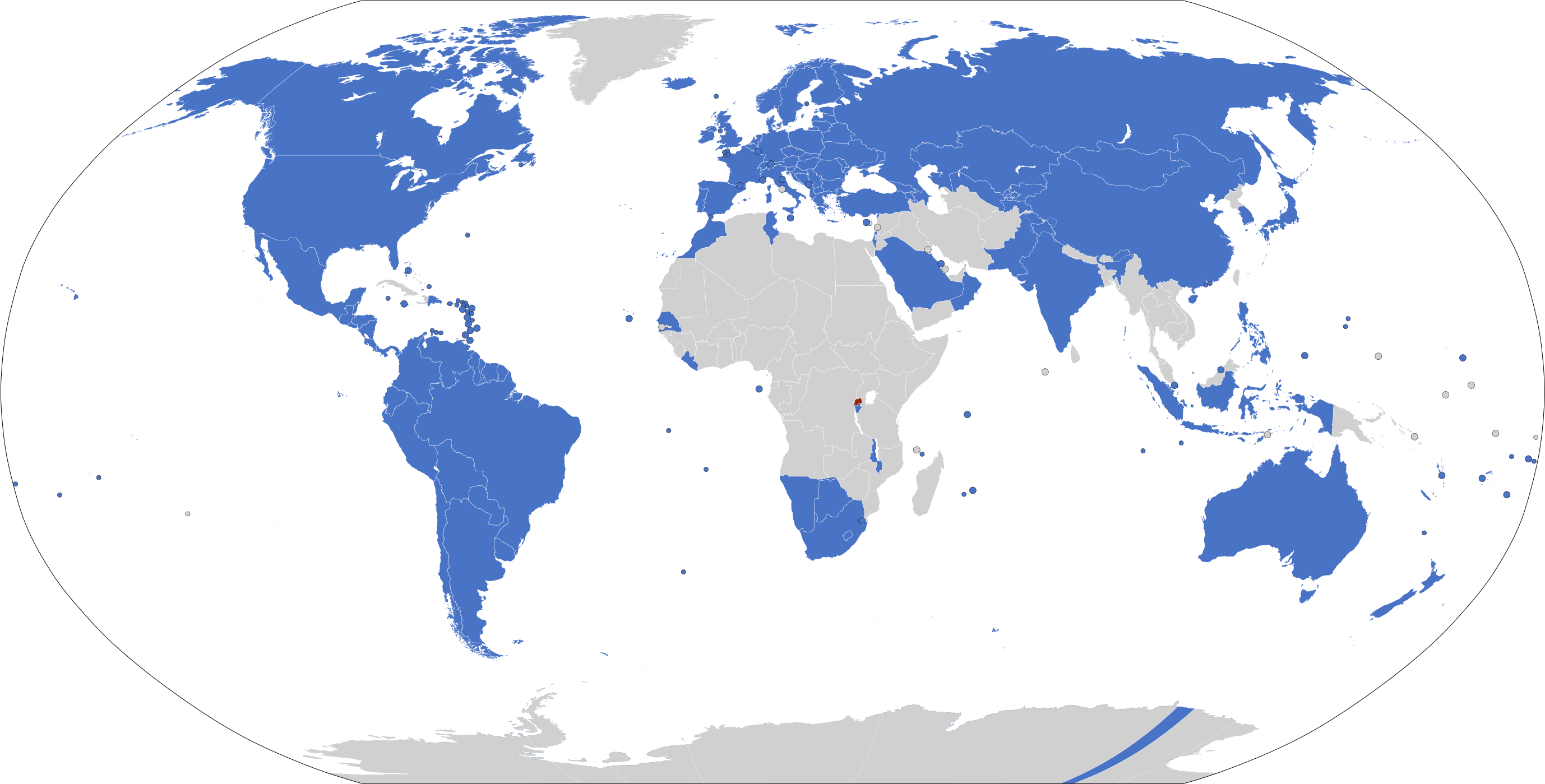
To date, the following Asian and transcontinental states are Contracting Parties to the Apostille Convention:
Georgia, India, Indonesia, Israel, Japan, Kazakhstan, Kyrgyzstan, Mongolia, Oman, Pakistan, the Philippines, the Republic of Korea, Saudi Arabia, Singapore, Tajikistan, Türkiye, and Uzbekistan.
Vietnam deposited its instrument of accession on 31 December 2025; the Convention will enter into force for Vietnam on 11 September 2026. Until that date, Vietnamese documents still require consular legalization.
Thailand's Cabinet has approved accession but the instrument has not yet been deposited.
Please note that, under Article 12 of the Convention, accession takes effect only between the acceding state and those Contracting States that have not raised an objection. As a result, the apostille is not always accepted on a bilateral basis — in particular, Germany has lodged objections to the accession of several Asian states, so documents issued in those countries
still require the traditional legalization procedure when intended for use in Germany. Please consult the relevant country page for the up-to-date bilateral status.
States not party to the Convention
For public documents issued in Asian countries that are not parties to the Apostille Convention (e.g., the United Arab Emirates, Malaysia, Vietnam until 11 September 2026), consular legalization is required. This is a multi-step procedure: the document is first certified by the competent domestic authority (commonly a notary or a sectoral ministry), then by the Ministry of Foreign Affairs of the issuing state, and finally legalized at the consulate of the destination state. A document legalized in this manner is valid only in the country whose consulate carried out the legalization.
Apostille and consular legalization from Asia