

One of the most commonly requested types of documents for use abroad is educational documentation, in particular higher and vocational education diplomas, as well as school certificates. These documents are required for admission to foreign educational institutions and for employment abroad.
In most cases, educational documents issued in one country cannot automatically be used in another country. Special administrative procedures are usually required, most commonly legalization and nostrification (recognition).
States often have agreements that waive legalization and nostrification requirements, but such agreements should be treated with some caution. Certain organizations may still require a document to be apostilled despite the existence of an interstate treaty on legal assistance, while the waiver of nostrification may apply only to specific periods of time.
Diplomas, certificates, school certificates and other educational documents issued in one country may have legal validity in another country under applicable international agreements. However, for recognition and use in many other countries, such documents may first need to be legalised or apostilled, depending on the countries concerned and the applicable rules.
If you plan to use a Belarusian diploma in a country that is a party to the 1961 Hague Convention, it can be legalized for admission to a university through the simplified procedure known as apostille certification.
Why and when is an apostille required?
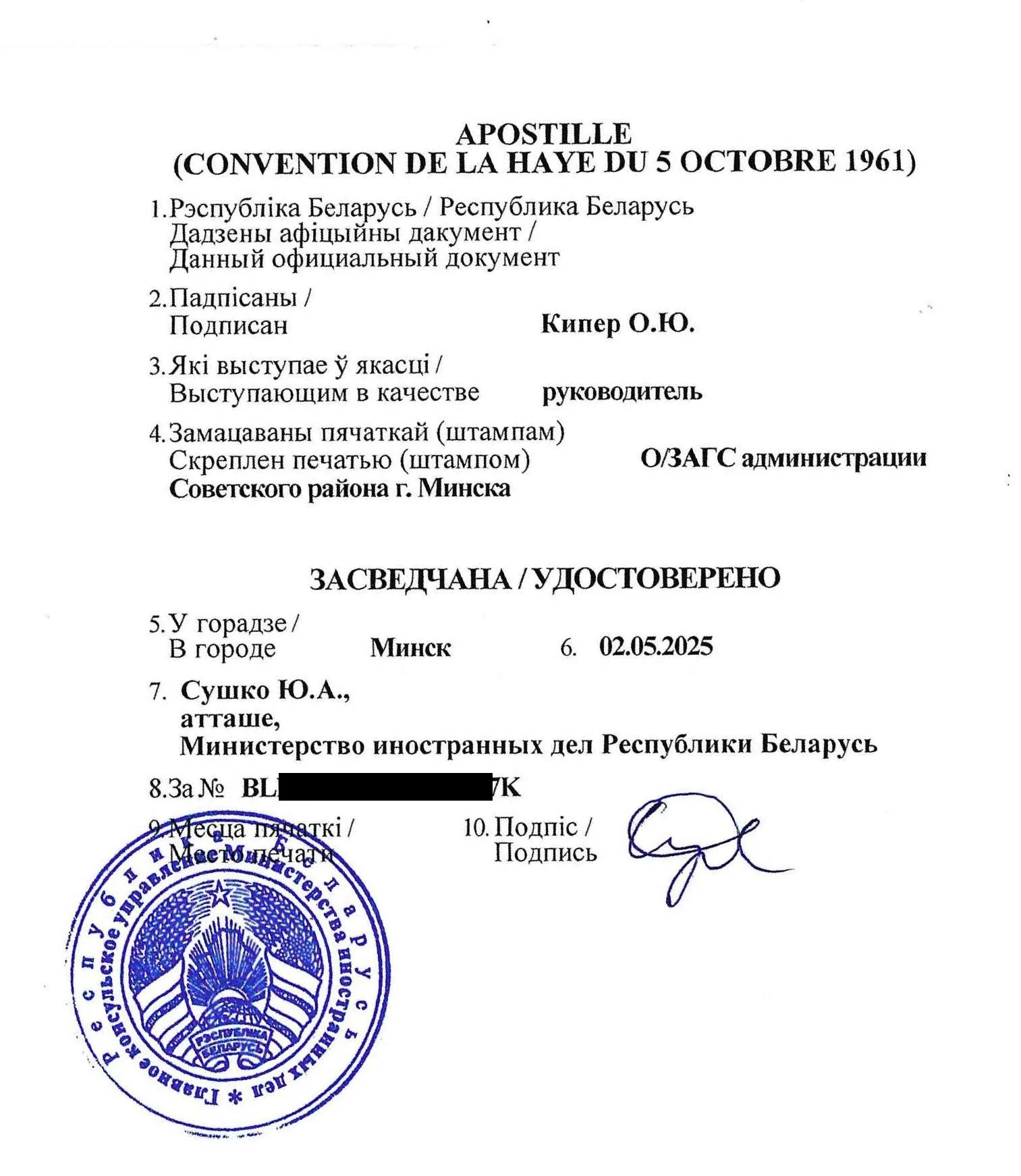
An apostille is a special stamp that certifies the authenticity of an official document. It can be affixed to documents issued by government authorities, local self-government bodies, educational institutions, and organizations that have been granted special powers by the state.
Commercial documents cannot be apostilled. Therefore, if you have received a certificate confirming completion of an educational course from a private company that does not hold an educational license, it cannot be apostilled. The apostille procedure can only be used to legalize documents issued by certified educational institutions holding an official state license.
It should be noted, however, that an apostille certifies the fact that a document was issued and confirms the authenticity of the signature of the authorized official. It does not automatically grant the right to work in regulated professions, such as medicine or law, and does not replace the recognition of higher education — nostrification.
An apostille can only be affixed in the country where the document was issued. It cannot be obtained through diplomatic or consular offices.
When is an apostille not required?
Most commercial organizations do not require employees to have their diplomas or other educational documents legalized by apostille when hiring them for positions that do not involve special access to information. In addition, a diploma does not need to be apostilled if a special regime for the mutual recognition of diplomas and academic degrees is in force between Belarus and another country, which may affect the possibility of admission to universities or employment in the relevant profession.
For example, Belarus is a party to the 1993 Minsk Convention. Therefore, an apostille is generally not required for diplomas issued in Belarus when they are used in most CIS countries. A notarized translation of the diploma into the official language of the country where the document will be used is sufficient.
However, neighboring Ukraine withdrew from the Minsk Convention in December 2022. Therefore, Belarusian diplomas and school certificates must be apostilled for use in Ukraine.
Before using a Belarusian educational document abroad, it is advisable to check with the relevant authorities in the destination country whether an apostille will be required.
Educational documents of Belarus
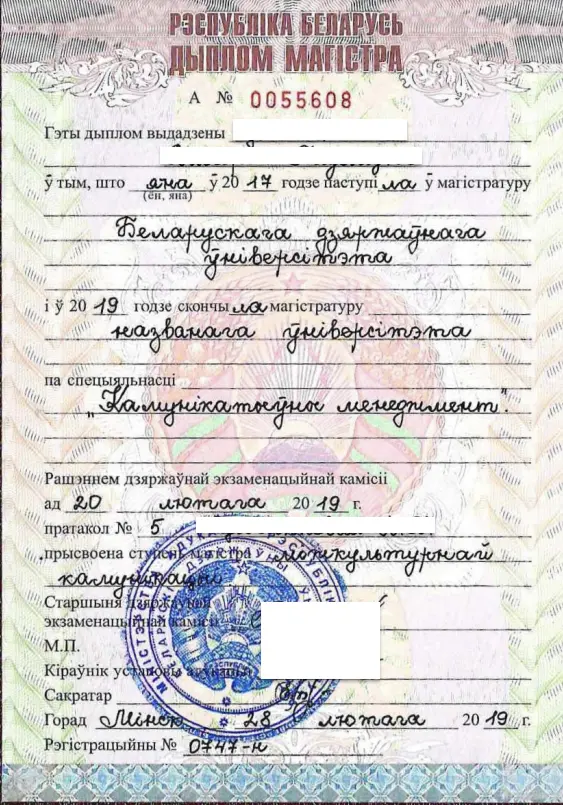
Educational documents in Belarus are issued upon completion of higher and vocational education institutions, schools, courses, and other educational programs.
The main types of educational documents in Belarus include:
- Diploma of Vocational Education;
- Diploma of Vocational Education with Distinction;
- Diploma of Specialized Secondary Education;
- Diploma of Specialized Secondary Education with Distinction;
- Diploma of Retraining at the Specialized Secondary Education Level;
- Higher Education Diploma;
- Higher Education Diploma with Distinction;
- Master's Degree Diploma;
- Diploma of Retraining at the Higher Education Level;
- Certificate of General Secondary Education (upon completion of 11 years of schooling);
- Certificate of General Basic Education (upon completion of 9 years of schooling).
In addition, students may receive certificates or other supporting documents in certain circumstances.
Procedure for apostilling diplomas and school certificates in Belarus
The apostille certification system for educational documents in Belarus is centralized. The Department for Education Quality Control is responsible for apostilling diplomas, school certificates, and other official educational documents. Since 2026, it has been officially authorized to carry out apostille certification; previously, it exercised powers delegated by the Ministry of Education in this area.
In the 2020s, the Belarusian authorities introduced a number of restrictions concerning the apostille certification of educational documents.
Apostilles can only be obtained while physically present in Belarus.
Educational documents in Belarus can only be apostilled by prior appointment. An appointment must be made through a dedicated electronic service, with the details of the document specified in the application.
When making an appointment in advance, the applicant must provide:
- surname, first name, and patronymic;
- type of document being submitted;
- document number;
- appointment date;
- appointment time.
This creates certain difficulties for school graduates who plan to apply to foreign universities, as they can only make an appointment for apostille certification after graduating. Given the time required for the certification itself, meeting the deadlines for submitting documents to the admissions office may be challenging.
A diploma or school certificate can be submitted for apostille certification by a representative acting under a power of attorney. However, if the applicant is a Belarusian citizen, the power of attorney must be issued in Belarus. Foreign nationals may issue a power of attorney in the country of which they are residents.
What is an apostille?
What is an apostille? Why do I need an apostille? How do I get an apostille? - Our video will explain everything you need to know about the apostille. If you have a document that needs to be certified with an apostille for use abroad, Schmidt and Schmidt will assist you! We provide apostille services in more than 100 countries worldwide.
Document delivery from Belarus
Despite the complex international situation, documents can still be sent from Belarus. However, for some destinations, delivery can only be arranged in several stages. For example, direct document shipments between Belarus and Ukraine are not available.
Consular legalization of Belarusian diplomas and school certificates
If the country where a Belarusian educational document is to be used is not a party to the 1961 Hague Convention, such as the United Arab Emirates, the document must undergo the more costly and complex procedure of consular legalization (referred to as “legalization” in official documents).
Consular legalization is a multi-stage procedure for certifying the authenticity of a document, used for countries that are not parties to the 1961 Hague Convention.
To have a Belarusian diploma or school certificate consularly legalized, the following steps must be followed:
- obtain the document;
- have the document legalized by the Ministry of Foreign Affairs of Belarus (if necessary, first obtain a notarized copy of the document);
- have the document translated by a notary;
- have the document legalized by the consulate or consular section of the embassy of the destination country.
Due to the number of steps involved, the procedure can be lengthy and quite costly. Some countries do not have consulates in Belarus, in which case the final stage of legalization may have to be completed in another country where the relevant consulate is located.
What is consular legalization?
In our video we are explaining what consular legalization is and where to apply for it.
Schmidt & Schmidt will assist you in all issues concerning the legalization.
Schmidt & Schmidt offers legalization in more than 80 countries all over the world.
How can we help?
We will be happy to assist you with apostilling and legalizing documents for use abroad.
You can always contact Schmidt & Schmidt. We have extensive experience in legalizing a wide range of documents and provide all the necessary services in this area, including obtaining notarized copies, translation, preparation of the necessary powers of attorney, legalization of documents with government authorities and consulates of foreign states, and delivery of completed documents to most countries worldwide.
For more information about the legalization and apostille procedures, please visit our website.
Translation of an educational document
When using an educational document issued in Belarus in a foreign country, an official translation (notarized, sworn, court-certified, or certified) must be prepared in accordance with the legal requirements of the country where the document will be used.
The translation must undergo a verification process. This involves sending the completed translation to the graduate for review to ensure that the spelling of their first and last name, the subjects studied, and the titles of academic papers are correct, as inaccuracies may occur during translation.
Depending on the requirements of the applicable national legislation, the official translation may be attached to an apostilled notarized copy of the document.
What comes next?
Once you have obtained a legalized diploma, together with a copy to which a notarized translation has been attached, the documents can generally be considered officially ready for use abroad.
As for countries with which Belarus has no agreements on legal assistance and the recognition of foreign documents, a diploma must be submitted for nostrification in the destination country after being apostilled or consularly legalized and officially translated.


